For some time now, there has been a page of Wikipedia that I keep finding myself in Complex Systems . But complex systems is an enormous field, so, for this post, I will be talking about one “branch” of systems theory, Cybernetics.
Cybernetics is a transdisciplinary field, meaning it intersects with many different disciplines, so it’s weird in the way that it doesn’t have an identity of its own. I had heard of concepts related to cybernetics in machine learning, psychology, biology, design, linguistics, and even art. The meaning most often associated with the word cybernetics is that of the cyborg, cyberspace, or technology/internet-related vocabulary, which is mostly because the prefix cyber was “stolen” by science fiction authors like William Gibson (Neuromancer, Cyberspace…) that made cyber have the meaning that it has today (cybersecurity, cyberbullying…). It was later used by Donna Haraway in her Cyborg Manifesto
 that I plan to write about soon, but doesn’t have anything to do the kind of cybernetics I care in this post.
The definition of cybernetics is the field of systems science that studies circular causal systems whose outputs are also inputs, and feedback systems. If you are familiar with delays in music production, you probably already have that concept interiorized. The most intuitive examples are thermostats (where the action of a heater responds to changes in temperature to preserve certain state). The first cybernetic machine designed by humans was probably the Watt steam engine
, cornerstone of the Industrial Revolution in England.
The etimology of the word comes from greek κυβερνήτης, meaning captain, steersman or guide. It the same root kubernetes, meaning governor. The steersman interpretation is perhaps the most correct one, as in steering a ship, the steersman maintains a steady course in a changing environment by adjusting in continual response to the effect it is observed as having. It involves changing the environment to perpetuate itself.
Cybernetics has been practiced by every being unconsciously at least since the beginning of evolution. Biology was the seed of cybernetic thinking (think of how hunger works) and remains one of the most prominent fields. The term was coined by Rober Weiner in his book, “Cybernetics: Or Control and Communication in the Animal and the Machine”, after studying parallels between regulatory feedback processes in biological and technological systems. Cybernetics, much like computer science in the 50s and 60s, was fragmented into different sciences, and while CS was able fuse into its own giant concept, cybernetics remains a niche spread throughout philosophy, business management, politics, and sciences.
The history of cybernetics is fascinating to me, as it managed to influence some of the most ahead-of-their-time thinkers in almost every field of study. The part of cybernetics that interests me the most is related to intelligence and consciousness. If you have read my post on The Loping Effect , many of the concepts are strikingly similar. The human brain is a cybernetic machine at its core, and the most probable way I can see to AGI involves having a deeper understanding of the feedback systems. Artificial intelligence involves feedback systems by definition, and my intuition says that consciousness does too. Cybernetics can explain agency without resorting to God or a shallow understanding of the brain. Languages are good examples of cybernetic systems that, without any kind of conscious thought, change constantly to stay afloat, autocorrection through feedback.
The beginning can be traced back to Rober Weiner, who during WW2 was inspired by his work on the automatic aiming and firing of anti-aircraft guns to formulate the first steps of this field, and along with people like McCulloch and von Neumann developed much of the original concepts. Some of those include Self-organization, Negative Feedback, or the Good Regulator Theorem . Cybernetics is entangled with Information Theory, and Weiner´s original work touched many of the same concepts that Shannon did. Later on, during the '60s and '70s, some other people took that work, mostly relegated to hard sciences, and applied it to social, ecological, and philosophical concerns.
One cool idea that arose here was that of Second-Order Cybernetics . Associated with Radical Constructivism, this new term extends the principles of cybernetics to include the observer as an integral part of the system. It acknowledges that the act of observation can influence the behavior of the system being observed. This new paradigm didn’t fit well with those working in engineering cybernetics and deepened the differences between the different branches of though.
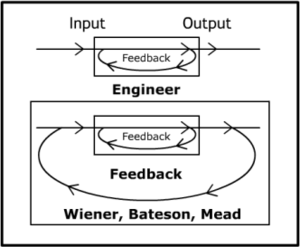
This new approach where the observer is part of the system becomes more interesting once you realize that almost everything can be seen as a system, and the observer himself is the one that places the line between what is inside it.
Around the same time, Stafford Beer was garnering success applying cybernetics in companies, the so-called management cybernetics. He developed the viable system model, to diagnose the faults in any existing organizational system, and worked great for the steel industry. He was presented with the chance to take his skills to Chile, where the government of Salvador Allende had started rapidly nationalizing many corporations (some of them from the EEUU) to move towards a more centraliced economic system. Fernando Flores and other people realized that the sudden amount of work would make central planning extremely difficult, and sought his help in creating a system to alleviate that problem.
This group was nicknamed the “Santiago Boys” which, with the addition of Stafford, started a project to construct a distributed decision support system to aid in the management of the national economy, It was called Cybersyn (Cybernetics + Synergy). As good as that sounds, they were in the 70s and South-America, so resources were scarce. They found 500 unused telex machines and built a network between factories to report on all kinds of variables (raw materials, supply and demand…). They had many other plans, namely a statistical alerting and planning software (Cyberstride) and an economic simulator (CHECO). Unluckily, a coup the etat in 1973 would stop their efforts, and the whole system ended up getting little use.

The one time where it would come in handy was during October 1972, when about 40,000 truck owners took on strike, and the system was used to help with the efforts of traversing the situation. They were also quite invested in the aesthetic aspect of it, and their Operations Room made Nixon quite angry since he had declared "not a nut or a bolt
 would go to Chile as long as they embraced socialism.
This podcast offers a great breakdown of the events (it doesn’t dive much into the technology itself thought), and while the political currents
 didn’t help the project, the tools weren’t quite there as well1. Some other similar efforts arose in the Soviet Union, but it all revolves back to the economic calculation debate. The economy is one of the biggest complex systems that humanity has created and is dependent on the feedback mechanism. I´m convinced that cybernetic planning can do a better job than a classical free market in many aspects, especially in those where government intervention is required either way. Cybernetics could have been socialism’s greatest ally, but unluckily collectivism was defeated too early to make use of the technological advancements of today.
Time will tell if I´m right, but the way I see it, mega-corporations like Amazon or Walmart are already doing that, and it’s going pretty good for them. As the aforementioned Good Regulator Theorem states, “every good regulator of a system must be a model of that system”, so to me it makes sense that as technology improves we are capable of making better models that surpass the human understanding of this system. In a way we are already living in a cybernetic society, but certainly not in the way that Beer envisioned it. In his view, the way to balance individual autonomy and community in complex systems is by managing them from the bottom up (that’s one of the reasons why Allende liked his plan), and that isn’t the case now.
To dive a little deeper into the economic aspect of cybernetics, George Soros (like him or not he has proven to develop one of the most accurate models of humanity), developed the theory of reflexivity
 to explain how markets work, and it’s basically a cybernetic approach to the economy. Markets are basically viable systems, and while powerful by themselves, they must accept their role as a part of a bigger viable system (society).
There is much to be said about cybernetics, but nowadays there is few people talking about it. Paul Pangaro is probably the person doing the most for the dissemination of cybernetic though, and many of his interviews are valuable. In my uni (computer science), cybernetics were metioned twice that I remember, in Embedded Systems and in Robotics (Weiner was mentioned and negative feedback explained, but only in the context of robots.The teacher defined cybernetics as the method of controlling a robot, while acknowledging that it was a difficult term).
Some interesting links:
Cybernetic Socialism Cybernetics around the world
 Cybersyn 1
 Cybersyn 2
 Principia Cybernetica Web
American Society for Cybernetics 1
 American Society for Cybernetics 2
Viable Systems
Cybernetics and War
Coenetic Variable is a cool concept, “a variable that is a common causal determinant of both system state and environmental disturbance” (G. Sommerhoff).
For comparison, in 1971 there were only 15 nodes (mostly in universities) in ARPANET, the network that would go on to form the Internet. ↩︎
Traducido con un LLM del original en inglés.
Desde hace un tiempo hay una página de Wikipedia en la que no paro de acabar: Complex Systems. Pero los sistemas complejos son un campo enorme, así que en este post voy a hablar de una “rama” de la teoría de sistemas, la cibernética.
La cibernética es un campo transdisciplinar, es decir, se cruza con muchas disciplinas distintas, así que es rara en el sentido de que no tiene una identidad propia. Había oído hablar de conceptos relacionados con la cibernética en machine learning, psicología, biología, diseño, lingüística e incluso arte. El significado que más se asocia a la palabra cibernética es el del cíborg, el ciberespacio o el vocabulario relacionado con la tecnología/internet, sobre todo porque el prefijo ciber fue “robado” por autores de ciencia ficción como William Gibson (Neuromancer, Cyberspace…), que le dieron a ciber el significado que tiene hoy (ciberseguridad, ciberacoso…). Más tarde lo usó Donna Haraway en su Cyborg Manifesto, sobre el que tengo pensado escribir pronto, pero no tiene nada que ver con el tipo de cibernética que me interesa en este post.
La definición de cibernética es el campo de la ciencia de sistemas que estudia los sistemas de causalidad circular, cuyas salidas son también entradas, y los sistemas de feedback. Si estás familiarizado con los delays en producción musical, probablemente ya tengas ese concepto interiorizado. Los ejemplos más intuitivos son los termostatos (donde la acción de un calefactor responde a cambios de temperatura para mantener cierto estado). La primera máquina cibernética diseñada por humanos fue probablemente la máquina de vapor de Watt
, piedra angular de la Revolución Industrial en Inglaterra.
La etimología de la palabra viene del griego κυβερνήτης, que significa capitán, timonel o guía. Es la misma raíz que kubernetes, que significa gobernador. La interpretación del timonel es quizá la más correcta, ya que al gobernar un barco, el timonel mantiene un rumbo estable en un entorno cambiante ajustando continuamente en respuesta al efecto que observa que tiene. Implica cambiar el entorno para perpetuarse a sí mismo.
Todo ser ha practicado la cibernética de forma inconsciente por lo menos desde el principio de la evolución. La biología fue la semilla del pensamiento cibernético (piensa en cómo funciona el hambre) y sigue siendo uno de los campos más destacados. El término lo acuñó Rober Weiner en su libro “Cybernetics: Or Control and Communication in the Animal and the Machine”, tras estudiar los paralelismos entre los procesos de feedback regulador en sistemas biológicos y tecnológicos. La cibernética, igual que la informática en los 50 y 60, estaba fragmentada en distintas ciencias, y mientras que la informática consiguió fusionarse en su propio concepto gigante, la cibernética sigue siendo un nicho repartido entre la filosofía, la gestión empresarial, la política y las ciencias.
La historia de la cibernética me fascina, porque consiguió influir a algunos de los pensadores más adelantados a su tiempo en casi todos los campos de estudio. La parte de la cibernética que más me interesa es la relacionada con la inteligencia y la consciencia. Si has leído mi post sobre The Loping Effect, muchos de los conceptos son sorprendentemente parecidos. El cerebro humano es en esencia una máquina cibernética, y el camino más probable que veo hacia la AGI pasa por entender más a fondo los sistemas de feedback. La inteligencia artificial implica sistemas de feedback por definición, y mi intuición dice que la consciencia también. La cibernética puede explicar la agencia sin recurrir a Dios ni a una comprensión superficial del cerebro. Los idiomas son buenos ejemplos de sistemas cibernéticos que, sin ningún tipo de pensamiento consciente, cambian constantemente para mantenerse a flote, autocorrección mediante feedback.
El origen se remonta a Rober Weiner, que durante la Segunda Guerra Mundial se inspiró en su trabajo sobre el apuntado y disparo automático de cañones antiaéreos para formular los primeros pasos de este campo, y junto a gente como McCulloch y von Neumann desarrolló gran parte de los conceptos originales. Algunos de ellos son la autoorganización, el feedback negativo o el Good Regulator Theorem. La cibernética está entrelazada con la teoría de la información, y el trabajo original de Weiner tocaba muchos de los mismos conceptos que el de Shannon. Más adelante, durante los 60 y 70, otra gente cogió ese trabajo, relegado sobre todo a las ciencias duras, y lo aplicó a cuestiones sociales, ecológicas y filosóficas.
Una idea chula que surgió aquí fue la de la cibernética de segundo orden. Asociado al constructivismo radical, este nuevo término extiende los principios de la cibernética para incluir al observador como parte integral del sistema. Reconoce que el acto de observar puede influir en el comportamiento del sistema observado. Este nuevo paradigma no encajó bien con los que trabajaban en cibernética de ingeniería y ahondó las diferencias entre las distintas ramas de pensamiento.
Este nuevo enfoque en el que el observador forma parte del sistema se vuelve más interesante cuando te das cuenta de que casi todo puede verse como un sistema, y que es el propio observador quien pone la línea de lo que queda dentro.
Más o menos por la misma época, Stafford Beer estaba cosechando éxitos aplicando la cibernética en empresas, la llamada cibernética de gestión. Desarrolló el modelo de sistema viable para diagnosticar los fallos de cualquier sistema organizativo existente, y funcionó genial para la industria del acero. Se le presentó la oportunidad de llevar sus habilidades a Chile, donde el gobierno de Salvador Allende había empezado a nacionalizar rápidamente muchas empresas (algunas de EEUU) para avanzar hacia un sistema económico más centralizado. Fernando Flores y otra gente se dieron cuenta de que la repentina cantidad de trabajo haría la planificación central extremadamente difícil, y buscaron su ayuda para crear un sistema que aliviara ese problema.
A este grupo lo apodaron los “Santiago Boys” y, con la incorporación de Stafford, empezaron un proyecto para construir un sistema distribuido de apoyo a la toma de decisiones que ayudara en la gestión de la economía nacional. Se llamó Cybersyn (Cybernetics + Synergy). Por bien que suene, estaban en los 70 y en Sudamérica, así que los recursos eran escasos. Encontraron 500 máquinas de télex sin usar y montaron una red entre fábricas para informar de todo tipo de variables (materias primas, oferta y demanda…). Tenían muchos otros planes, en concreto un software estadístico de alertas y planificación (Cyberstride) y un simulador económico (CHECO). Por desgracia, un golpe de estado en 1973 frenaría sus esfuerzos, y el sistema entero acabó usándose poco.
La única vez en que vino bien fue en octubre de 1972, cuando unos 40.000 propietarios de camiones se pusieron en huelga, y el sistema se usó para ayudar a sortear la situación. También estaban bastante metidos en el aspecto estético, y su Sala de Operaciones cabreó bastante a Nixon, ya que había declarado que "ni una tuerca ni un tornillo iría a Chile mientras abrazasen el socialismo.
Este podcast ofrece un gran desglose de los hechos (aunque no profundiza mucho en la tecnología en sí), y aunque las corrientes políticas no ayudaron al proyecto, las herramientas tampoco estaban del todo a la altura1. Surgieron otros esfuerzos similares en la Unión Soviética, pero todo vuelve al debate del cálculo económico. La economía es uno de los mayores sistemas complejos que ha creado la humanidad y depende del mecanismo de feedback. Estoy convencido de que la planificación cibernética puede hacerlo mejor que un libre mercado clásico en muchos aspectos, sobre todo en aquellos en los que la intervención del gobierno hace falta de todas formas. La cibernética podría haber sido el mayor aliado del socialismo, pero por desgracia el colectivismo fue derrotado demasiado pronto para aprovechar los avances tecnológicos de hoy.
El tiempo dirá si tengo razón, pero tal y como yo lo veo, megacorporaciones como Amazon o Walmart ya lo están haciendo, y les va bastante bien. Como dice el ya mencionado Good Regulator Theorem, “every good regulator of a system must be a model of that system”, así que para mí tiene sentido que, a medida que mejora la tecnología, seamos capaces de hacer mejores modelos que superen la comprensión humana de este sistema. En cierto modo ya vivimos en una sociedad cibernética, pero desde luego no como la imaginaba Beer. En su visión, la forma de equilibrar la autonomía individual y la comunidad en sistemas complejos es gestionándolos de abajo arriba (esa es una de las razones por las que a Allende le gustaba su plan), y ahora mismo no es el caso.
Para profundizar un poco más en el aspecto económico de la cibernética, George Soros (te guste o no, ha demostrado desarrollar uno de los modelos más precisos de la humanidad) desarrolló la teoría de la reflexividad para explicar cómo funcionan los mercados, y es básicamente un enfoque cibernético de la economía. Los mercados son básicamente sistemas viables, y aunque son potentes por sí mismos, tienen que aceptar su papel como parte de un sistema viable más grande (la sociedad).
Hay mucho que decir sobre la cibernética, pero hoy en día poca gente habla de ella. Paul Pangaro es probablemente la persona que más está haciendo por la difusión del pensamiento cibernético, y muchas de sus entrevistas valen la pena. En mi uni (ingeniería informática), la cibernética se mencionó dos veces que yo recuerde, en Sistemas Empotrados y en Robótica (se mencionó a Weiner y se explicó el feedback negativo, pero solo en el contexto de los robots. El profesor definió la cibernética como el método para controlar un robot, aunque reconoció que era un término difícil).
Algunos enlaces interesantes:
Socialismo cibernético
La cibernética por el mundo
Cybersyn 1
Cybersyn 2
Principia Cybernetica Web
American Society for Cybernetics 1
American Society for Cybernetics 2
Sistemas viables
Cibernética y guerra
Coenetic Variable es un concepto chulo, “a variable that is a common causal determinant of both system state and environmental disturbance” (G. Sommerhoff).
Para comparar, en 1971 había solo 15 nodos (la mayoría en universidades) en ARPANET, la red que acabaría formando Internet. ↩︎