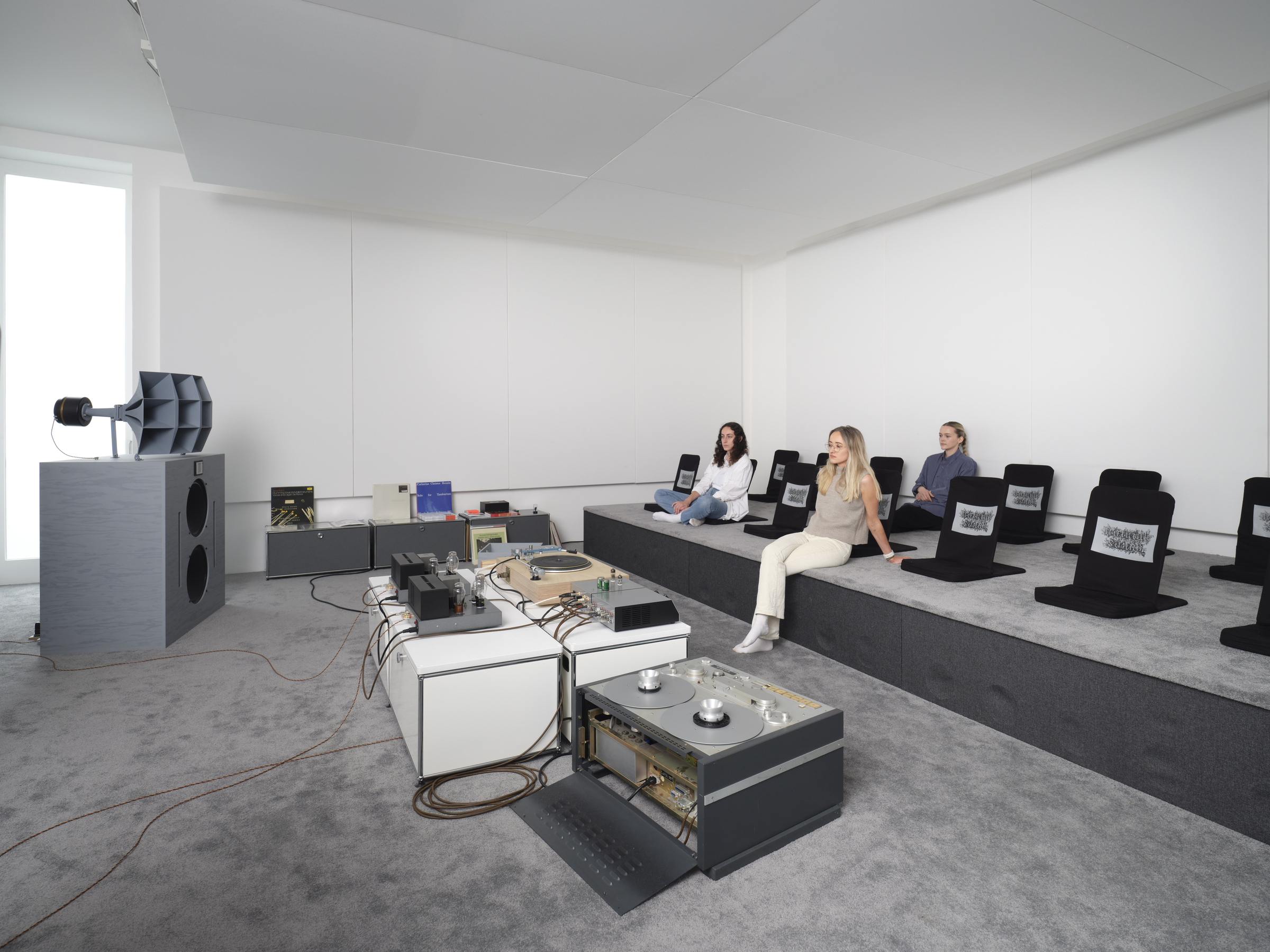
On my recent trip to London, I visited the Lisson Gallery where they were hosting the “HiFi listening Room Dream No.1” . The event was put together by Devon Turnbull
 (aka OJAS) and was completely free. I and my friend got to catch Mo Yasin
 in residence (8–11 August). Also worth mentioning is that most of the system was built from scratch by OJAS and his team.
The objective was to allow people to listen to the sound system he had created in a curated environment, with focus on active listening. He referred to it as a “spiritual gathering”. I personally profoundly enjoyed the experience and I believe that anyone else would, from a music enthusiast to a music negationist. Not necessarily because of the high quality of the audio, but for many other reasons I will soon get into.

Be aware, I´m gonna use this post to talk about a bunch of related topics that have been rounding my mind ever since I decided to dive deep into music production, mixing/mastering, and the way that we interpret music as humans.
Unluckily, I was only able to experience the room for half an hour, since we arrived just in time for the last session of the day. It honestly felt like no time at all. My mind was racing during and after the event with thoughts and inflammable opinions. I decided to write this post so I can get some of them in order and, with some luck, make someone angry at me.
I liked a quote from this review ,
(…) But this isn’t about tastes aligning or loving every record he puts on. It’s about the act of sitting in this room and listening. And that act is genuinely powerful, meditative, vital; it’s a break with the outside world. It makes you realize how little you actually listen in real life, how much sound you take for granted.
as it highlights what for me is the strongest point of the installation. The experience between listening to music on your headphones on the street and inside that room is so vastly different that it feels weird to consider them the same activity. Listening in a room full of people changes the way we perceive sounds, not only on an acoustic level (usually, bass frequencies are more controlled and fewer reflections occur, but it depends a lot on the venue configuration and materials) but also on a psychological one (I will get more into this later).
The implied imposition of silence in the space and the aesthetical choices made are just some of the ingredients used to create the conditions in which you are obliged to pay your full attention to the music. The crowd was varied in age and background, some people chose to meditate while others were taking photos or drawing in a notebook.
From this point forward, I want to make a distinction between two concepts that can be a bit confusing. I will use the word psychoacoustics when referring to the way that we humans perceive sound, from the moment it comes out of an instrument or a speaker up to the point where moving fluid bends thousands of hair-like cells which convert the vibrations into nerve impulses. Music psychology is a more broad container that includes psychoacoustics but also many other phenomena associated with music and the human brain.
Some interesting examples of psychoacoustics are sound localization, missing fundamental or the masking effects that happen when listening when playing more that one sound at the same time. Personally, I am mostly interested in the way that we can use these biological factors to our advantage when making music or building systems to play it. I will add some cool examples in the appendix.
This installation took all this into account, the expensive equipment utilized and the positioning of it all, along with the size of the room and the acoustic panels on the wall were making fair use of all this information, as expected of a hi-fi system. One of the first things you learn as an audio engineer is that no matter how good your equipment is, if your room sounds bad, your music will sound bad.
On this London trip, I also ended up going to a christian church on sunday morning, after having a long talk with Nice Guy Luke, who saw me listening in to their student reunion in a Hyde Park gazebo. While it gave me a lot to think about in the context of religion and human coercion, that is not the topic of this post. If you are curious you can read this and this
 , as they are both pretty accurate recollections of my experience.
This church is relevant to the post because it confirmed once again a concept that I have been talking about for a long time. There is something special about listening to music, we all know that, but there is something maybe even more special in performing it. And now imagine performing in a church among hundreds of other people, in a heavily emotionally/spiritually charged environment, all while feeling part of a deeply rooted community. I wholeheartedly believe that this is the reason for many spiritual revelations and conversions. This experience confirmed for me that is one of the most extreme cases of applied music psychology that I can think of, and I´m sure you can see the similarities with the previously mentioned exhibition.
I would like to briefly mention the increasingly popular auditory illusion of binaural beats * . While the scientific evidence is not yet conclusive in any direction, I find them quite interesting since they stand at the intersection of trying to use a psychoacoustics concept to hopefully evoke a psychological effect through brain waves, all that mixed in with a heavy placebo effect and the psychological effects of music itself.
Pythagoras thought that sound and music could be understood from a purely physical standpoint. Later on, Aristoxenus declared that music could only be understood through human perception and its relation to human memory. My understanding is that music is an experience unique to each person, and as such is hugely influenced by your own past and your present.
This brings me to probably my most contentious argument, how we can judge if any music sounds good or bad. Of course, I´m not talking about whether the music itself is good or not. I am of the firm opinion that all sounds created by humans with the intention to be listened to by humans categorizes as music and it all holds exactly the same value. No exceptions. Really none. I plan on writing a more detailed piece on that, focusing not only on music but on art in general.
Knowing this, how is it that one can judge if a piece of music sounds better than another? As we previously established, music is an experience, but the moment it involves more than one person it can also work as a way of communicating, and as such, it has developed its own language over time. Naturally, this language is different depending on culture and technological advancements, but what it allows us to do is set standards and make comparisons among material using the same, or very similar rules.
There is an interesting question as to how much of a mix or master engineer´s job is creative. Most of the time, I believe it is, since there are infinite choices on how you can get a song to sound good (conform to the language in use), but if you are only trying to fit a song to the current set of rules and not taking any “risks” I will probably have difficulty fitting that in the art category. I honestly feel more comfortable saying that some AIs are creative (at August 2023) than many other traditionally artistic endeavors.
The following part is not necessarily referring to this event in particular since it mostly advertised itself as a spiritual gathering but to the audiophile community in general. Hi-fi (meaning high fidelity) main purpose is to try to get the sound to reproduce as close to the original recording as possible. That means achieving a frequency response as flat as possible and minimizing distortion and noise. It´s quite easy to see the flaws in that logic since the mixing and master process wasn’t necessarily done on a flat monitoring system. Notably, Yamaha’s NS-10s, known to be one of the most popular and time-tested speakers in the industry, do not have a very flat response. That, plus the fact that the response also varies depending on the room it was mixed, on top of having to trust the mix done, most likely, by a 60-year-old man who can´t even distinguish sounds above 12 kHz.

But I know it´s not really fair, since the real objective of this (really expensive) system it´s not to achieve a perfect recreation of the recording, but a pleasant one. That´s why many still use vinyl, even though it introduces way more distortion and noise than digital and many other problems. Amongst those imperfections and limited dynamic ranges is where the so-called “warmth” of analog hides. And, let´s make it clear, there´s nothing wrong with that, I believe that it sounds better for many people, but I think it has more to do with what kind of sound are our ears more used to, and the fact that mastering for vinyl is a different process than mastering for digital, usually involving more analog gear (with the same thing happening here, it doesn’t necessarily sound better but we are more used to it sonic characteristics).
What should not be underestimated is the power of the aforementioned music psychology in this process. And that is easily proven seeing the rejection that blind tests have in the audiophile community. As Robert Harley of The Absolute Sound wrote: “…blind listening tests fundamentally distort the listening process and are worthless in determining the audibility of a certain phenomenon.”
I certainly would have liked to perform some blind tests with the sound system in that room, or at least be able to compare it to something of similar loudness, but I do understand that what they are selling is an experience. I sincerely hope that they start embracing that more and add a couple more rituals to the show. Personal recommendations include incense, subway surfer videos on the walls, and mind-altering substances. That last one might not be that far, as stated in the press release:
(…) the sense of community and shared practice, as well as the power of mind and conscious altering behaviors – in tandem with his parents who now academically advise on psilocybin studies – has inspired the energy and identity of HiFi Listening Room Dream No. 1.
Appendix
interesting psychoacoustics and music psychology examples: 1, 2 , 3, 4, 5, 6.
Traducido con un LLM del original en inglés.
En mi último viaje a Londres visité la Lisson Gallery, donde tenían montado el “HiFi listening Room Dream No.1”. El evento lo organizó Devon Turnbull (alias OJAS) y era totalmente gratis. Mi amigo y yo pillamos a Mo Yasin en residencia (8–11 de agosto). También vale la pena mencionar que la mayor parte del sistema lo construyeron desde cero OJAS y su equipo.
El objetivo era que la gente pudiera escuchar el equipo de sonido que había creado en un entorno cuidado, con el foco en la escucha activa. Él lo llamaba una “reunión espiritual”. A mí personalmente me encantó la experiencia y creo que a cualquiera le gustaría, desde un melómano hasta un negacionista de la música. No necesariamente por la alta calidad del audio, sino por muchas otras razones en las que voy a entrar enseguida.
Aviso, voy a usar este post para hablar de un montón de temas relacionados que me rondan la cabeza desde que decidí meterme a fondo en la producción musical, la mezcla/el mastering y la forma en que los humanos interpretamos la música.
Por desgracia, solo pude disfrutar de la sala media hora, porque llegamos justo a tiempo para la última sesión del día. Sinceramente, se me hizo cortísimo. Durante y después del evento la cabeza me iba a mil, llena de ideas y opiniones inflamables. Decidí escribir este post para poner algunas en orden y, con un poco de suerte, conseguir que alguien se enfade conmigo.
Me gustó una cita de esta reseña,
(…) But this isn’t about tastes aligning or loving every record he puts on. It’s about the act of sitting in this room and listening. And that act is genuinely powerful, meditative, vital; it’s a break with the outside world. It makes you realize how little you actually listen in real life, how much sound you take for granted.
porque resalta lo que para mí es el punto más fuerte de la instalación. La experiencia de escuchar música con los cascos por la calle y la de escucharla dentro de esa sala son tan tremendamente distintas que se hace raro considerarlas la misma actividad. Escuchar en una sala llena de gente cambia la forma en que percibimos los sonidos, no solo a nivel acústico (normalmente los graves están más controlados y hay menos reflexiones, pero depende mucho de la configuración y los materiales del sitio) sino también a nivel psicológico (entraré más en esto luego).
La imposición implícita de silencio en el espacio y las decisiones estéticas son solo algunos de los ingredientes que se usan para crear unas condiciones en las que estás obligado a prestarle toda tu atención a la música. El público era variado en edad y procedencia; algunos optaban por meditar mientras otros hacían fotos o dibujaban en un cuaderno.
A partir de aquí quiero distinguir entre dos conceptos que pueden ser un poco confusos. Voy a usar la palabra psicoacústica para referirme a la forma en que los humanos percibimos el sonido, desde el momento en que sale de un instrumento o un altavoz hasta el punto en que un fluido en movimiento dobla miles de células con forma de pelo que convierten las vibraciones en impulsos nerviosos. La psicología de la música es un contenedor más amplio que incluye la psicoacústica pero también muchos otros fenómenos asociados a la música y el cerebro humano.
Algunos ejemplos interesantes de psicoacústica son la localización del sonido, la fundamental ausente o los efectos de enmascaramiento que se producen al escuchar cuando suena más de un sonido a la vez. Personalmente, lo que más me interesa es cómo podemos usar estos factores biológicos a nuestro favor al hacer música o al construir sistemas para reproducirla. Añadiré algunos ejemplos chulos en el apéndice.
Esta instalación tenía todo esto en cuenta: el equipo caro que usaban y cómo estaba colocado, junto con el tamaño de la sala y los paneles acústicos de la pared, hacían buen uso de toda esta información, como cabe esperar de un sistema hi-fi. Una de las primeras cosas que aprendes como ingeniero de sonido es que da igual lo bueno que sea tu equipo: si tu sala suena mal, tu música va a sonar mal.
En este viaje a Londres también acabé yendo a una iglesia cristiana un domingo por la mañana, después de una larga charla con Nice Guy Luke, que me vio escuchando la reunión de estudiantes que tenían en un templete de Hyde Park. Aunque me dio mucho en lo que pensar en cuanto a religión y coerción humana, ese no es el tema de este post. Si tienes curiosidad puedes leer esto y esto, porque los dos son relatos bastante fieles de mi experiencia.
Esta iglesia es relevante para el post porque me confirmó una vez más una idea de la que llevo hablando mucho tiempo. Escuchar música tiene algo especial, eso lo sabemos todos, pero interpretarla tiene algo quizá todavía más especial. Y ahora imagina tocar en una iglesia entre cientos de personas, en un ambiente cargadísimo emocional/espiritualmente, mientras te sientes parte de una comunidad muy arraigada. Creo de todo corazón que esta es la razón de muchas revelaciones espirituales y conversiones. Esta experiencia me confirmó que es uno de los casos más extremos de psicología de la música aplicada que se me ocurren, y seguro que ves las similitudes con la exposición de antes.
Me gustaría mencionar brevemente la ilusión auditiva cada vez más popular de los binaural beats *. Aunque la evidencia científica todavía no es concluyente en ningún sentido, me parecen bastante interesantes porque están en la intersección entre intentar usar un concepto de psicoacústica para, con suerte, provocar un efecto psicológico a través de las ondas cerebrales, todo ello mezclado con un buen efecto placebo y los efectos psicológicos de la propia música.
Pitágoras pensaba que el sonido y la música se podían entender desde un punto de vista puramente físico. Más tarde, Aristóxeno declaró que la música solo se podía entender a través de la percepción humana y su relación con la memoria humana. Mi forma de verlo es que la música es una experiencia única para cada persona, y como tal está enormemente influida por tu propio pasado y tu presente.
Esto me lleva a probablemente mi argumento más polémico: cómo podemos juzgar si una música suena bien o mal. Por supuesto, no hablo de si la música en sí es buena o no. Soy de la firme opinión de que todos los sonidos creados por humanos con la intención de que los escuchen humanos cuentan como música y todos tienen exactamente el mismo valor. Sin excepciones. Ninguna, de verdad. Tengo pensado escribir algo más detallado sobre eso, centrándome no solo en la música sino en el arte en general.
Sabiendo esto, ¿cómo puede uno juzgar si una pieza de música suena mejor que otra? Como ya hemos establecido, la música es una experiencia, pero en el momento en que implica a más de una persona también puede funcionar como una forma de comunicación, y como tal, ha desarrollado su propio lenguaje con el tiempo. Naturalmente, este lenguaje cambia según la cultura y los avances tecnológicos, pero lo que nos permite es fijar estándares y hacer comparaciones entre material usando las mismas reglas, o unas muy parecidas.
Hay una pregunta interesante sobre cuánto del trabajo de un ingeniero de mezcla o de mastering es creativo. La mayoría de las veces creo que lo es, ya que hay infinitas opciones sobre cómo conseguir que una canción suene bien (que se ajuste al lenguaje en uso), pero si solo intentas encajar una canción en el conjunto de reglas actual sin asumir ningún “riesgo”, probablemente me cueste meter eso en la categoría de arte. Sinceramente, me siento más cómodo diciendo que algunas IAs son creativas (a agosto de 2023) que muchas otras actividades tradicionalmente artísticas.
Lo que viene a continuación no se refiere necesariamente a este evento en particular, ya que se anunciaba sobre todo como una reunión espiritual, sino a la comunidad audiófila en general. El propósito principal del hi-fi (que significa alta fidelidad) es intentar que el sonido se reproduzca lo más parecido posible a la grabación original. Eso significa conseguir una respuesta en frecuencia lo más plana posible y minimizar la distorsión y el ruido. Es bastante fácil ver los fallos de esa lógica, ya que el proceso de mezcla y mastering no se hizo necesariamente en un sistema de monitorización plano. Sin ir más lejos, los NS-10 de Yamaha, conocidos por ser de los monitores más populares y probados de la industria, no tienen una respuesta muy plana. Eso, sumado a que la respuesta también varía según la sala en la que se mezcló, y encima tener que fiarte de la mezcla hecha, muy probablemente, por un señor de 60 años que ya ni distingue sonidos por encima de 12 kHz.
Pero sé que no es del todo justo, porque el objetivo real de este sistema (carísimo) no es conseguir una recreación perfecta de la grabación, sino una agradable. Por eso mucha gente sigue usando vinilo, aunque introduce muchísima más distorsión y ruido que el digital y muchos otros problemas. Entre esas imperfecciones y rangos dinámicos limitados es donde se esconde la famosa “calidez” de lo analógico. Y, que quede claro, no tiene nada de malo, creo que a mucha gente le suena mejor, pero me parece que tiene más que ver con a qué tipo de sonido están más acostumbrados nuestros oídos, y con que masterizar para vinilo es un proceso distinto a masterizar para digital, que normalmente implica más equipo analógico (y aquí pasa lo mismo, no suena necesariamente mejor pero estamos más acostumbrados a sus características sonoras).
Lo que no hay que subestimar es el poder de la psicología de la música que mencionaba antes en este proceso. Y eso se demuestra fácilmente viendo el rechazo que tienen las pruebas a ciegas en la comunidad audiófila. Como escribió Robert Harley, de The Absolute Sound: “…blind listening tests fundamentally distort the listening process and are worthless in determining the audibility of a certain phenomenon.”
Desde luego me habría gustado hacer alguna prueba a ciegas con el equipo de sonido de esa sala, o al menos poder compararlo con algo de un volumen parecido, pero entiendo que lo que venden es una experiencia. Sinceramente espero que empiecen a abrazar eso más y añadan un par de rituales más al espectáculo. Mis recomendaciones personales incluyen incienso, vídeos de subway surfers en las paredes y sustancias que alteren la mente. Esto último puede que no esté tan lejos, según la nota de prensa:
(…) the sense of community and shared practice, as well as the power of mind and conscious altering behaviors – in tandem with his parents who now academically advise on psilocybin studies – has inspired the energy and identity of HiFi Listening Room Dream No. 1.
Apéndice
ejemplos interesantes de psicoacústica y psicología de la música: 1, 2, 3, 4, 5, 6.